

Groundstrokes are usually among the first shots a player learns in tennis because they are the building blocks of rallies.
Any time you see two players hitting the ball back and forth after it lands, usually from around the the baseline, you are watching tennis groundstrokes.
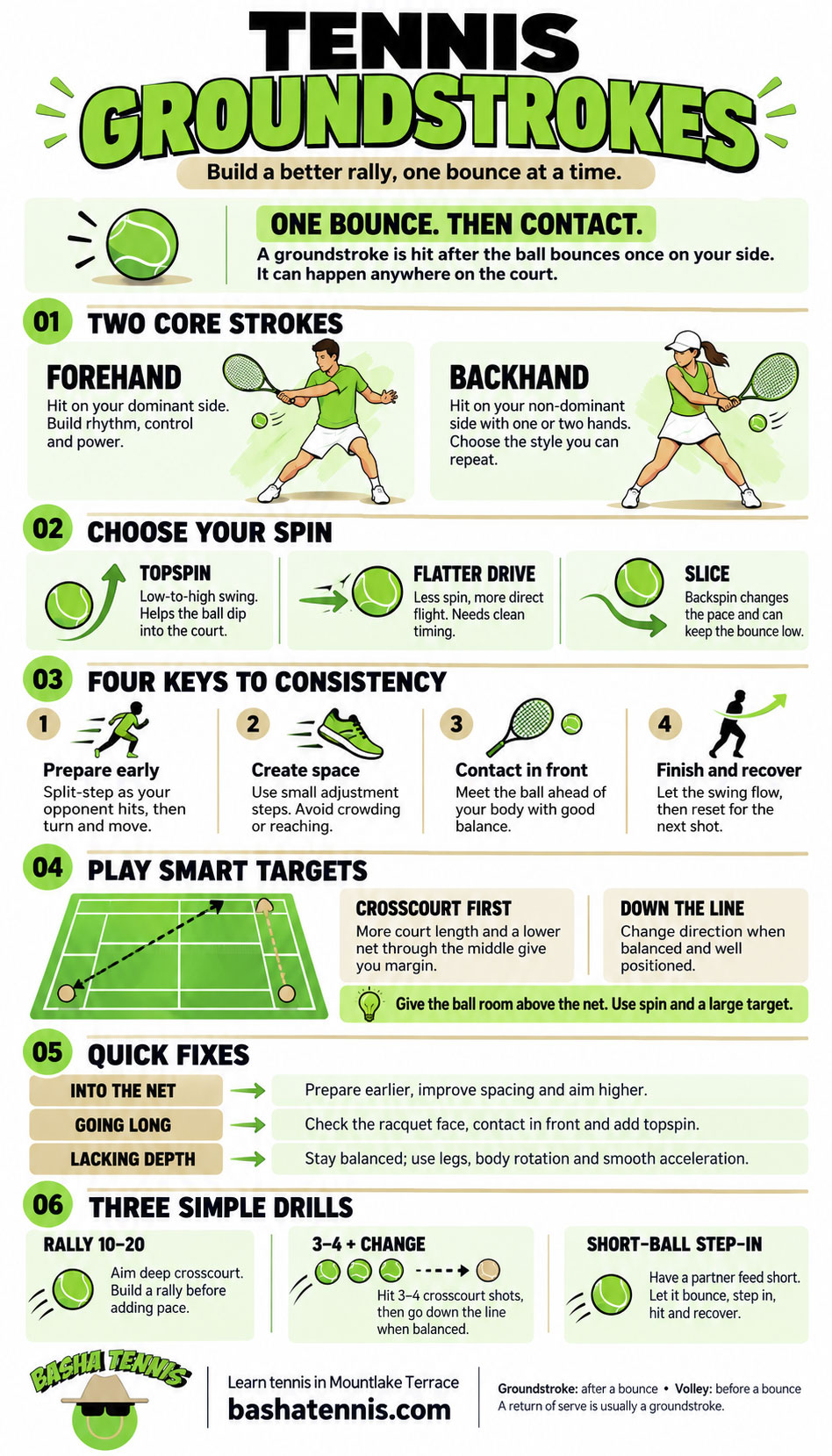
In basic terms, a groundstroke is a shot hit after the ball bounces once on your side of the court. Players usually hit groundstrokes from behind the baseline, but court position does not define the shot type. Rather, the type of bounce determines the type of stroke you hit.
This article describes what a groundstroke is and how it differs from other types of shots, provides information about the two main types of groundstrokes, and gives the reader effective techniques and drills to improve groundstrokes without making things too complicated.
Groundstrokes Are the Essence of Tennis
Groundstroke shots are struck during rallies after the ball bounces on your side of the court. The objective of hitting groundstrokes is to keep the ball in play as long as possible, move your opponent around the court, and create a scoring opportunity.
A groundstroke can also be executed inside the court, such as when taking a half volley off an opponent’s short shot that has bounced before contact, so do not think that groundstrokes occur only at the baseline.
Groundstrokes Vs Other Common Shots

There are some things that make the groundstrokes different from some other shots you commonly hear about, and these include when the ball is being hit.
The service shot is hit before the volley is played and therefore the point has not started yet.
The volley is usually played at the net but is hit before it bounces, while the overhead can be played from anywhere on the court and is played before the ball bounces like the serve to handle a lob.
There is a shot called a half volley, and the half volley is played immediately after a bounce, in most cases when the ball is placed in a low position and when the player is running toward the net. However, the half volley can also be played when the player moves into an awkward position on the court to make the shot.
Finally, the return of serve generally counts as its own category of hit, however, it is typically considered a groundstroke due to its arrival being faster and lower than normal rally shots.
2 Main Groundstrokes: Forehand & Backhand
The majority of players center their long-term game around a forehand and backhand. Typically, a forehand is played on the dominant side of the body, and most beginners find this stroke easier to learn than the backhand.
A forehand gives the hitting side of the body more freedom to develop rhythm and generate power on the ball in crosscourt rallies. Players often rely on their forehand to dictate the tempo of crosscourt exchanges and attack short balls when possible.
Backhands are executed on the nondominant side of the body with either one hand or two hands.
Two-handed backhands are often easier for players to establish control and composure with early in their development than a one-handed backhand. This is especially true as players face faster or higher bouncing balls.
In contrast, one handed backhands can create wider angles and add more variety to an overall game, but they typically require greater precision, timing, and strength to hit heavier balls than two-handed backhands.
Neither style is considered superior to the other, but instead represents two approaches based on overall comfort level, coaching, and the ability to perform consistently under competitive pressure.
Groundstroke Trajectory: Topspin, Flatter Drives, & Slice

Not all groundstrokes are created equally. Players are able to affect how the ball flies through the air and bounces after it hits the ground by altering its spin.
Topspin is by far the most frequently used spin in today’s tennis game, and as the name suggests, it causes the ball to rotate so it dips into the court and bounces higher than if it is not spinning. A common teaching cue when learning to hit topspin shots is low to high, where the player swings with upward acceleration through and forward contact with the ball.
When hitting a flatter drive shot, there is less spin on the ball compared to a topspin rally shot, so many players hit flatter drives with more pace and direction because they are easier to time. To execute this shot successfully, players need solid timing and strike the ball cleanly enough to maintain at least some margin for error compared to a heavier topspin ball.
When describing a shot as flat, keep in mind that every shot contains at least some spin, so a more accurate definition is that a flat shot has less spin than the average rally shot.
Backspin is produced when slicing a ball, and it is most commonly used on the backhand, although players also apply it on the forehand side.
Because sliced shots can stay lower in the air from contact to the court or provide a different rhythm for an opponent, they are ideal choices for players looking to buy time on defense or gain an advantage by forcing uncomfortable contact.
Tennis Groundstroke Basics
Technique is often complicated, but there are very few principles that improve your game that are both easy to understand and repeatable. All of these concepts are general coaching tips and do not apply to every player in exactly the same way. Groundstrokes begin before your actual swing with properly timed readiness, mindset, and movement.
Balancing yourself in an appropriate ready position and executing an appropriate split step, a small jump, as your opponent strikes the ball allows you to react earlier to contact, which reduces the time it takes to get your feet moving.
Improving your preparation timing typically has a greater impact on whether you are late than trying to swing faster.
The next element is spacing. Players typically miss shots because they get too crowded on the ball or reach. You need to make contact far enough away from your body to allow for a free swing but close enough to maintain good balance without stretching. The easiest way to check is to try to hold your finish without losing your balance or stumbling to either side.
Once you achieve proper contact with the ball, you can focus on the finish.
The finish requires different forms of contact depending on the style of player present, but one way to improve your finish is to try to meet the ball in front of you rather than letting it go past you. The follow-through of your stroke is the product of a good swing movement of the club and good spacing, and not something you force when swinging the club.
If a player’s finish is short or jabby, it usually means the player makes contact late or does not take enough time to swing correctly. If a player’s finish is erratic, it usually means the player has poor balance or uses too much power because of a lack of control.
Groundstroke Targets: Crosscourt Vs Down The Line
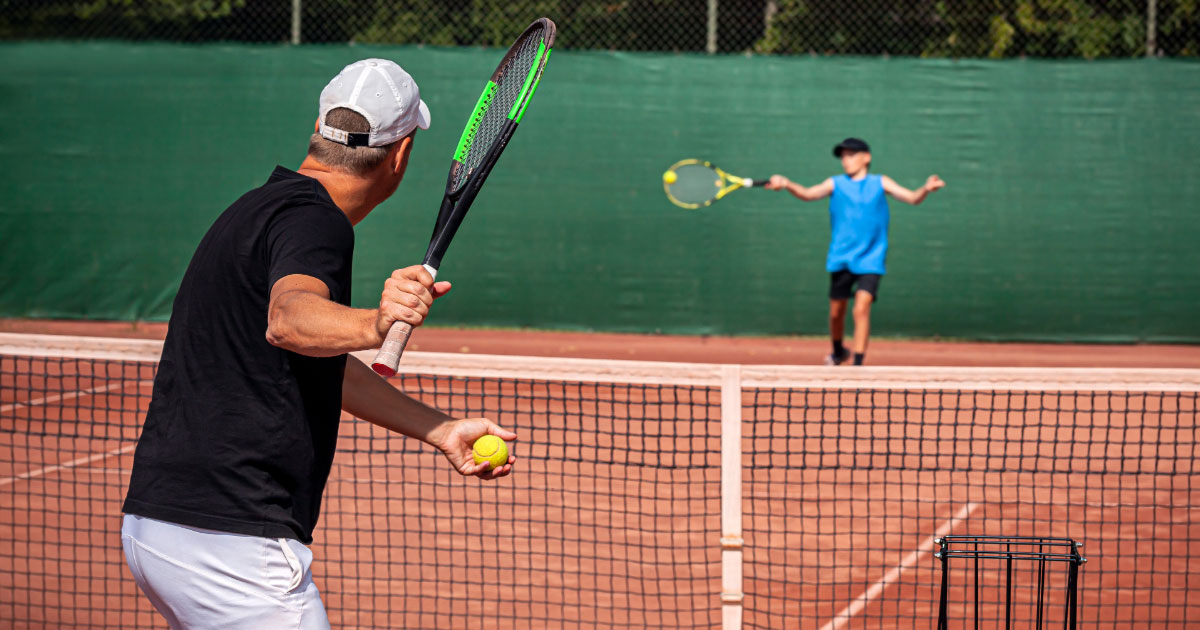
Once your shot-making becomes consistent, the two most useful multipliers for improving your results are targets and height over the net.
In general, crosscourt targets are the default option because the net is lower in the middle, and hitting diagonally gives you more distance on the court than hitting straight down the sideline.
Hitting down the line is a good choice for changing direction or attacking but offers less margin for error if you are late or off-balance.
Typically, players develop consistent shot-making to the crosscourt side of the court first and then build the ability to hit down the line after they establish a strong foundation in their stroke production.
Another simple way to improve your shot-making is to hit with more height over the net. Many developing players get into trouble by keeping the ball too low and hitting the net. But when you hit higher than you normally would with moderate clearance and use spin, and depth, to bring the ball back down, you develop reliability faster than if you try to hit as close as possible to the net.
Common Groundstroke Problems & Safe Fixes
If you keep hitting the net when playing tennis, the problem is usually one to three things:
- Improper timing of your shot (i.e., late contact);
- Not using your feet to get in position (i.e., reaching); or
- Only using your arm to hit the ball (i.e., swinging primarily with your arm).
The best way to fix these issues is to prepare for your shots earlier, move to create space between you and the ball, and give yourself more clearance over the net during practice to build a margin for error.
If you keep hitting the ball long, it is usually because you contact the ball with an open racquet face, let the ball drift behind you at contact, or swing up with the racquet without enough forward swing for height.
One way to reset your game is to focus on contacting the ball in front of your body, add topspin to your shot, and hit the ball to a larger target area instead of trying to hit a specific line.
Groundstrokes that are weak are not solved by muscling it up with your arm instead, they benefit from balance while hitting, smooth acceleration at the point of contact, and using your legs and body rotation.
A good test for power is whether you can complete your swing while controlling the racquet through impact, and how quickly you can recover after your shot. Build your depth first then, when you hit with accuracy, work on increasing your pace.
Simple Practice Drills That Build Real Groundstrokes
Improving your overall ability to hit consistently from a variety of positions can be done in several ways. One way is to target a large area with a deep crosscourt shot and adequate height over the net. You are looking for a longer rally rather than maximum pace. After you can sustain a rally for 10 to 20 consecutive shots, you can begin to increase your speed gradually.
Another effective pattern is developing crosscourt consistency before attacking out of the corners. Hit three or four successful crosscourt shots, then attack down the line after you have established full balance. With this approach, you train your ability to make the right decision to win a point. You are not hitting down the line because you feel like it. You are hitting down the line because you earn the ability to do so.
As you work on developing movement toward short balls, you need a partner to feed for you. Your partner tosses a short ball, and you allow the ball to bounce, then step in and hit a controlled groundstroke to a target area before recovering.
Most often, a player gains an advantage at some point during a rally when they are able to step into the court after hitting a short ball, so practicing movement and timing to execute this type of shot generally improves players overall performance in singles and doubles.
Practical Takeaways

Groundstrokes are shots struck after the ball bounces once on your side of the court. Most rallies in tennis are made up of forehand and backhand groundstrokes.
Your primary weapon during a rally tends to be topspin, since it gives you the greatest control. However, your most consistent success typically comes from the following factors: early preparation, spacing, and targeting.
If given the choice between hitting crosscourt or down the line, crosscourt almost always yields better results unless you are balanced and solid in your position.
FAQ About Tennis Groundstrokes
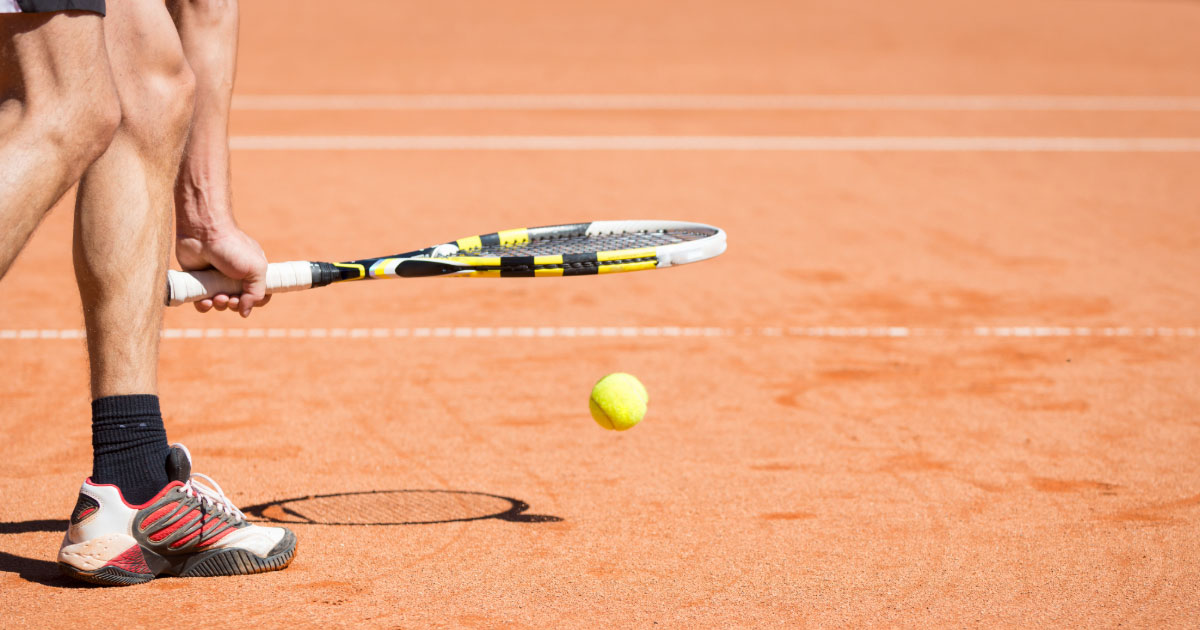
Here are a few questions new tennis players often have about hitting groundstroke shots:
#1 What Makes A Shot A Groundstroke?
If the ball bounces once before you hit it, it’s a groundstroke. If you hit it before it bounces, it’s a volley (or an overhead if it’s above your head).
#2 Is A Return Of Serve A Groundstroke?
Usually, yes, because the serve bounces first. People still call it a “return” because the speed and timing make it feel different from a normal rally ball.
#3 Can You Hit A Groundstroke Near The Net?
Yes. If you let the ball bounce first, it’s still a groundstroke even if you’re close to the net, though players often choose to volley in that area.
#4 Should Beginners Learn Topspin First?
Many beginners do well learning a gentle topspin shape because it helps the ball drop into the court, but the first priority is consistent contact and control.
#5 What Matters Most For Consistent Groundstrokes?
Many coaches prioritize timing, spacing, and balance because good feet put you in a repeatable contact zone, which makes the swing far easier to repeat.
Learn Groundstrokes & Tennis Basics in Mountlake Terrace
Groundstrokes (forehands and backhands) make up the primary shots used to hit a tennis ball during rallies after the ball bounces on the court first.
To rally consistently with your groundstrokes, you need early preparation, the ability to create enough space through positioning to enable you to swing freely, and a target area large enough to give you the latitude to miss a shot.
Once all of these are in place, adding more pace and variety becomes much easier. With quality tennis instruction at Basha Tennis, you quickly learn to master forehand and backhand strokes, ball placement, footwork, and more.
Sign-up today online for group youth lessons or adult classes. We also offer private lessons upon request.
In the meantime, please feel free to explore our website, including our tennis blog, glossary of tennis terms, and get to know our couches.


