

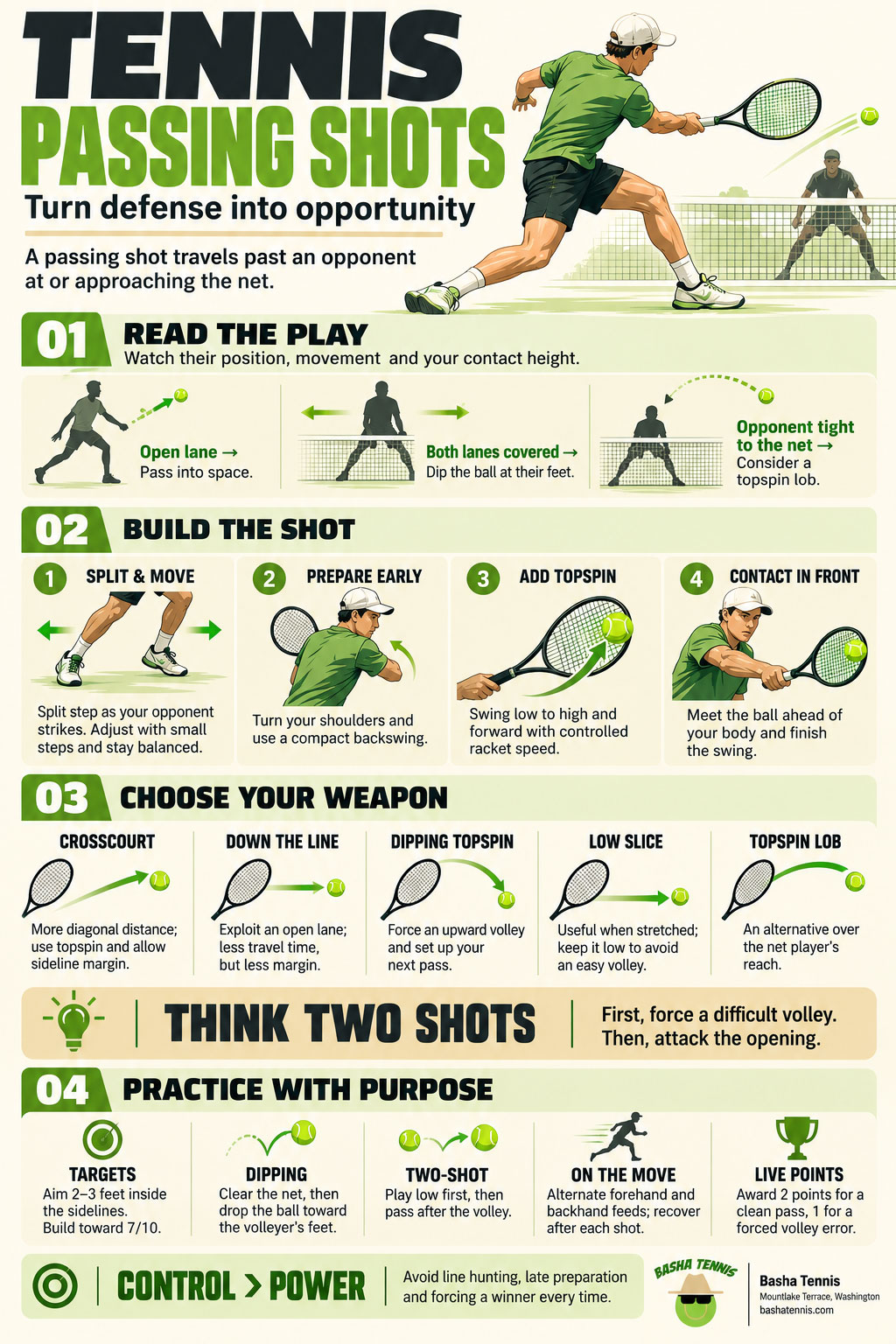
A passing shot, when executed perfectly, is one of the best offensive weapons in tennis. A passing shot that is well placed makes a good defensive play and gives a player a good chance of turning defense into a winning point when an opponent approaches the net.
Nevertheless, just hitting passing shots is not enough to succeed against a good player at the net. One needs good timing, topspin control, smart shot selection, effective footwork, and knowledge of court dimensions to be successful.
Mastering tennis passing shots requires building dependable forehand and backhand skills, being vigilant about your opponent’s positioning, and practicing in situations resembling actual competition. Whether you are a beginner learning to respond to players coming to the net or an advanced player perfecting your game, learning how to execute passing shots can improve your game.
What Exactly is a Tennis Passing Shot?
A passing shot is a shot played past an opponent who is usually at the net or racing to the net, preventing them from intercepting it. Unlike standard groundstrokes which are typically played from the baseline, the player must take into account that the opponent could intercept the ball before it bounces. A passing shot can be hit with a forehand or backhand, using topspin, a flat drive, or a low slice.
The Importance of Court Geometry
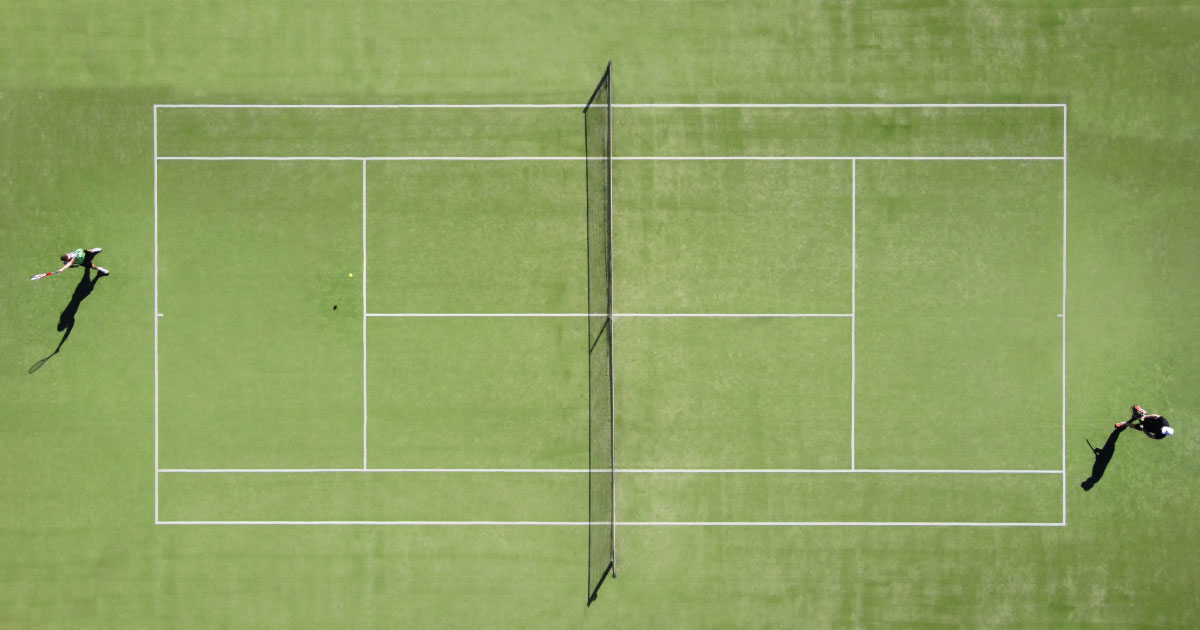
The International Tennis Federation (ITF) indicates that a standard tennis court’s dimensions are 78 feet (23.77 m) long, with the distance from the baseline to the net of 39 feet. The width of the court is 27 feet (8.23 m) for singles, whereas doubles court width is 36 feet (10.97 m). The height of the net is 3 feet (0.914 m) at the center and 3 feet and 6 inches (1.07 m) at the posts.
The size of the court influences the strategy for passing shots. One can utilize a longer diagonal trajectory with a cross-court shot as opposed to using a more precise down-the-line shot, which can give the opponent less time to execute their return at the same ball speed. Great players take advantage of geometric aspects to prioritize positioning, speed, rotation, and risk.
When Should You Attempt a Passing Shot?
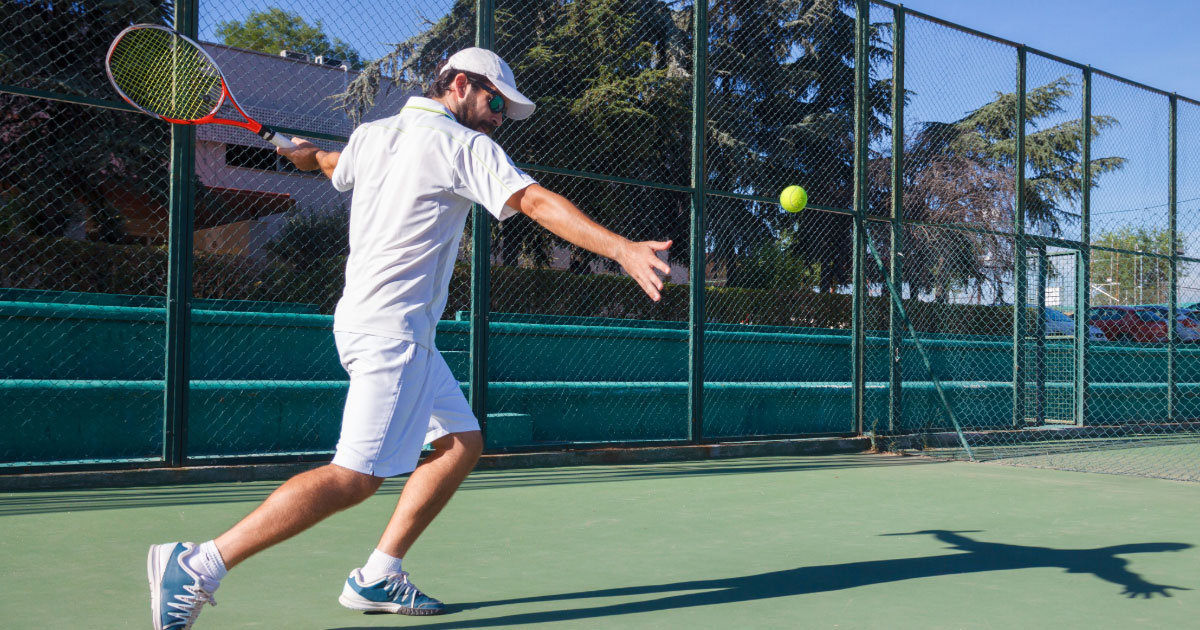
The occurrence of passing shots is primarily in situations where opponents are at the net or approaching from the back of the court toward the front. Situations that help one to decide when to execute passing shots include responding to an approach shot, neutralizing serve-and-volley plays, countering the chip-and-charge play, and getting out of an uncomfortable position on the court. It is important to keep in mind three key points before aiming for the target, such as where the opponent is, the direction in which they are moving, and the height of the incoming shot.
The adversary may be on the attack, but they could struggle to execute a low shot that is dropping near their feet. A player at the net can easily be caught off guard with a sharply angled passing shot or topspin lob.
It does not make sense to go for a winner on every shot. A successful first shot that forces a difficult volley can increase the likelihood of executing the next passing shot. Using two passes can work well against skilled volleyers.
How to Execute a Successful Tennis Passing Shot
Establish Proper Footwork and Balance
Successful passing shots kick into gear before you make contact with the ball. When your opponent makes contact with the ball, make a split step and then move quickly in the direction where the ball will land.
For bigger movements, use crossover steps. For smaller movements, like the last few adjustments to your hitting position, use smaller adjustment steps. Your body should be in a stable position, with flexed knees and enough distance from the ball.
An open or semi-open stance can also aid in producing rotational power. Balance is essential because too much side movement or leaning back can make it difficult to control the direction of the shot.
Prepare the Racket Early
Getting ready ahead of time gives players more time to execute their shots. As you approach the ball, turn your shoulders and prepare your racket. Avoid taking a huge swing while making fast returns.
You can use either an Eastern or semi-Western forehand grip to hit a powerful shot with topspin.
When it comes to performing a two-handed backhand, it’s an invaluable move in fast exchanges. However, if done flawlessly, a one-handed backhand is an excellent tool for creating angles. The continental grip is very helpful when making defensive slices.
Generate Controlled Topspin
Topspin is regarded as a major part of the passing shot in the current era. When players swing their rackets from low to high and forward through the ball, they impart forward rotation so that the ball dips toward the court. This allows players to produce more aggressive shots while still providing a buffer.
With topspin, players can send the ball over the net and make it dip below net height before reaching an opponent preparing to hit it. This makes it difficult for the opponent to play the ball aggressively since they must hit upward to clear the net. The right way to generate topspin is to use a low-to-high swing path with controlled racket head speed rather than relying on wrist action alone.
Control Contact Point and Follow-Through
Strike the ball in front of your body, with the racket’s face directed toward the target. The height of the incoming ball influences the type of stroke you use. The chance to make a successful attacking stroke is generally higher when playing a ball at waist height than a ball struck below the knee.
Playing low balls may require more caution and greater height over the net. The follow-through needs to be controlled with a proper eye on the contact zone. Do not halt your swing too early out of fear of a player moving in for a volley.
What Are the Most Effective Types of Passing Shots?
Crosscourt Passing Shot
A crosscourt passing shot moves across the court diagonally toward the opposite side. Its longer diagonal path, combined with the lower net near the center, offers a good opportunity for topspin shots.
Crosscourt shots can work well when opponents move to cover the down-the-line opening. Sharply angled crosscourt passes require control to avoid hitting wide.
Down-the-Line Passing Shot
When a shot follows the line, it is almost parallel to the sideline.
This shot can be especially effective when the opponent’s position is on the other side of the court. Although the shorter path can give the opponent less time to react, it also complicates the process because of the greater height of the net away from the center.
Dipping Topspin Passing Shot
The purpose of the dipping passing shot is to make the ball drop toward the opponent’s feet. Instead of aiming at the net player’s body, the goal is to create difficulty for them to hit a clean volley contact.
By using the dipping shot successfully, you can often make your opponent hit upward, leading to an easier second ball to attack. This technique is particularly useful against players coming up around the service line.
Slice Passing Shot
Slices with backspin can create a low bounce, and sometimes the ball skids after the bounce. They are used whenever a player is stretched, has to defend, or cannot make a proper topspin stroke.
A good controlled slice played to empty space can keep the point in play and disturb the opponent’s movement. However, a slow slice that goes high above the net may give an easy volley to the opponent.
Topspin Lob as an Alternative
A lob differs from standard passing shots, but it serves the same purpose tactically: it exploits someone who comes to the net.
With a successful topspin lob, the ball travels above the opponent’s reach and lands inside the court. Thus, against players at the net who might expect a low passing shot, a lob is advantageous. The ability to use both passing shots and lobs makes one’s tactics less predictable.
How Do You Choose the Right Passing-Shot Direction?
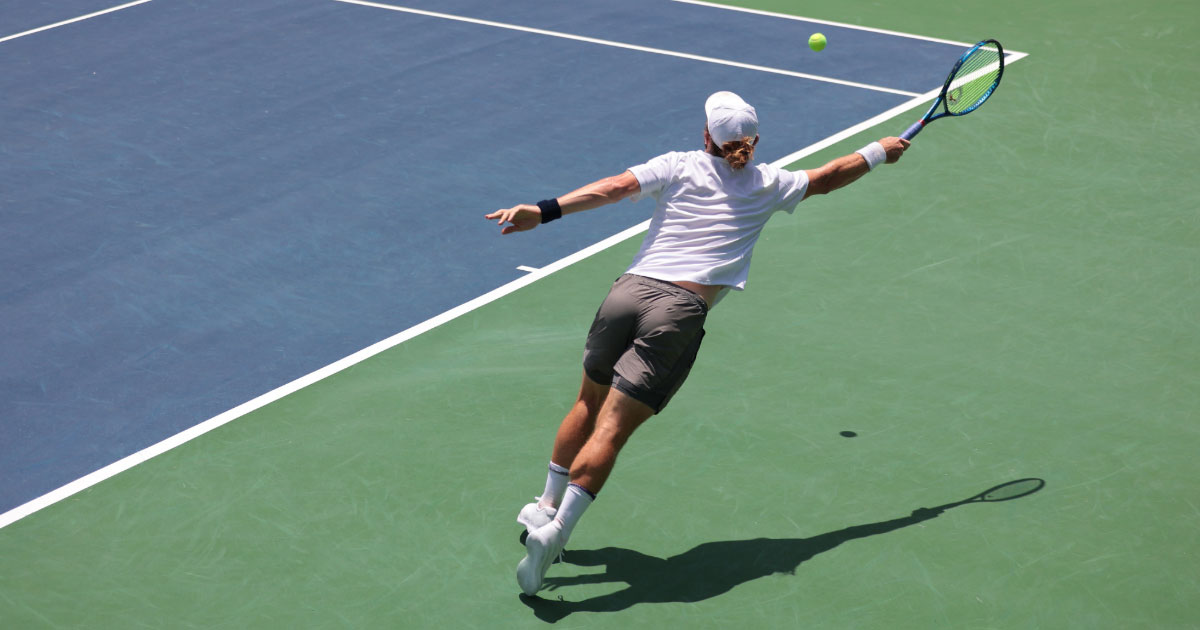
The best passing shot depends on the relative position of the opposing player as well as your own position and contact point. Pay attention to where the volleyer finishes their split step and to whether they appear to prefer one side or, unconsciously, lean toward a specific passing lane. An opponent moving in one direction may find it difficult to change direction to intercept the ball traveling in the opposite direction.
Against an opponent covering both passing lanes, a good way to set up the next shot is to play the ball low at the feet of your opponent instead of going for an immediate winner. Depending on the racket positioning, it could be a good tactic to use disguised shots, since similar preparation can be used for the cross-court and for the down-the-line shot.
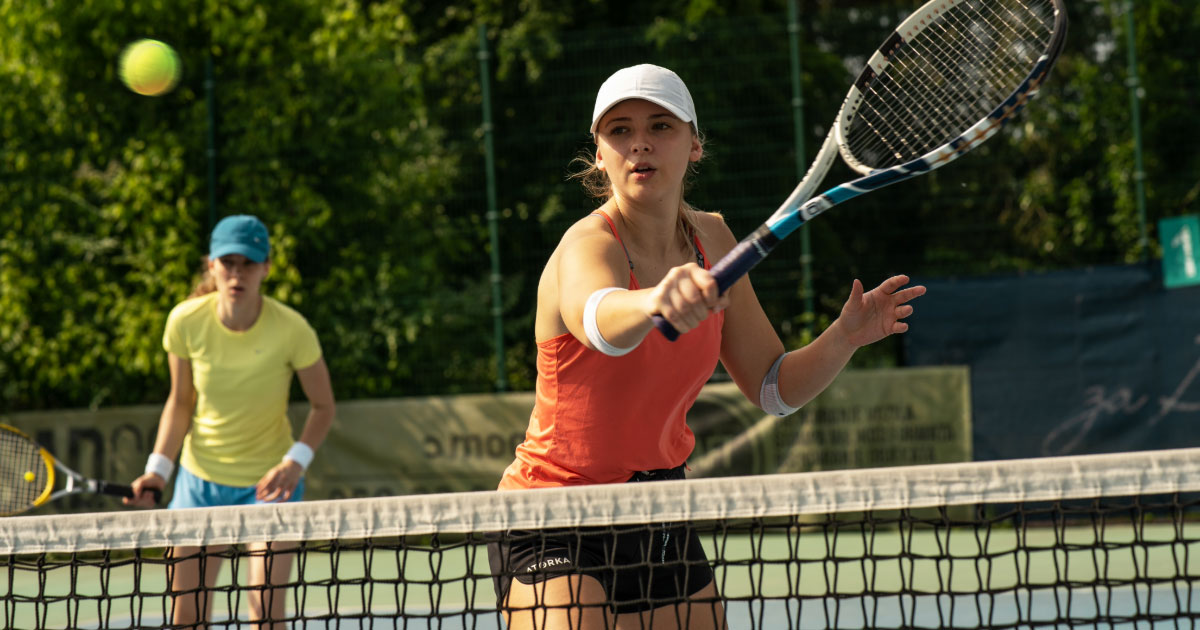
In doubles play, the choices of shots become bigger because the doubles alleys are in play. Moreover, players should remember that they have two opponents to worry about, including a player poaching, as well as possible gaps between the opponents.
Five Drills to Master Tennis Passing Shots
Structured repetition helps in developing shot accuracy, decision making, and confidence among players. The United States Tennis Association (USTA) Net Generation coaching program included activities related to competitive passing shots where baseline players face opponents at the net. The drills discussed in this section use similar principles and can be adjusted as per the situation’s demand.
Crosscourt and Down-the-Line Target Drill
Put targets about 2-3 feet inside the sidelines and have a partner feed you balls from across the court. Alternate forehand and backhand passes to both targets. Go at a relaxed pace until you get 7 out of 10 balls into the target zones.
Dipping Passing-Shot Drill
Have your partner stand near the service line on the opposite side of the net and feed balls to you at the baseline. Hit topspin balls that clear the net and drop below net height before reaching your partner. Focus on controlled topspin rather than maximum ball speed.
Two-Shot Passing Drill
Have a partner move to the net after playing a controlled groundstroke. Hit a low groundstroke to their feet, and then try to pass them after their volley. The aim of this practice is to develop the player’s patience, ability to build up points tactically, and ability to spot weaker second strikes.
Moving Passing-Shot Drill
Start near the center baseline with a coach feeding you alternating forehands and backhands from the side. Start running to each ball around the court, making the appropriate choice of lane to pass the ball and recovering to a useful position on defense. Keep a record of shots landing in the target areas and errors so that you can compute your progress.
Competitive Net-Attack Drill
In this game of points, one participant must head toward the net. The player at the back gets two points for a clean winner and one point for a volley error from their partner.
Players should take turns at the net. By following this scoring system, players are encouraged to execute smart passing shots without having to hit a winner on every point.
Common Passing-Shot Mistakes to Avoid
There are a number of mistakes that occur often enough to jeopardize a player’s consistency as a passer. Playing too aggressively: When you utilize too much racket speed without adequate spin/control, your chances of making errors greatly increase. Targeting near the lines: Before going for difficult winners, players should set up appropriate targets in the court.
Ignoring the opponent’s movement: By deciding upon a target beforehand and ignoring subsequent movement, the player may miss an open passing lane. Taking one’s time: Slow shoulder rotation and late racket preparation affect the effectiveness of the stroke.
Aspiring to win: Rather than trying to hit an immediate winner, it can be better to execute a good-quality low shot that forces the opponent into making a difficult volley. To sort this out, one needs to practice these skills technically, but also practice in realistic game situations to get everything right.
How Long Does It Take to Master Passing Shots?
It is impossible to provide a fixed timeline for perfecting tennis passing shots as it is a process dictated by factors like playing experience, consistency of groundstrokes, coordination of muscle movements, frequency of training, and the quality of training coaches. New players should first nail the technique of hitting forehands and backhands and then focus on hitting suitable passing shots. Players of the intermediate level should mainly work on improving their directional precision, topspin, and reaction to incoming opponents.
Advanced players need to focus on deception, anticipating the movements of their opponents, understanding defensive-to-offensive transitions, and making decisions while under pressure during matches. Keeping count of the successful attempts in practice sessions of 20-ball and 50-ball drills can help track consistency rather than simply counting their impressive winners.
Frequently Asked Questions About Tennis Passing Shots
What Is the Best Passing Shot in Tennis?
No passing shot is always the best. A crosscourt topspin shot can give you valuable directional margins, while a down-the-line passing shot can take advantage of an open lane on the side. The correct shot depends on the positioning of your opponent, how much time you have, and how high the ball is traveling.
Should Passing Shots Be Hit Flat or With Topspin?
Topspin is typically favored because it helps control the ball’s flight path and provides a greater margin for error. Flat shots can work in the case of opponents not being in the right spot and certain conditions being met by the player, such as having good stability and proper contact height.
Can Beginners Learn Tennis Passing Shots?
Yes. Beginners can start with controlled groundstrokes aimed toward open court. As consistency improves, they can incorporate topspin, sharper angles, footwork patterns, and competitive drills against net players.
Are Passing Shots Different in Singles and Doubles?
Indeed, in singles there is one opponent to pass, while in doubles it is necessary to consider two players and the available passing lanes. The players in doubles need to utilize the bigger court yet realize that a shot between the opponents or a lob may sometimes be more appropriate.
How Can I Improve Passing-Shot Accuracy?
Regularly practice the contact points, prepare the racket early, develop your ability to execute topspin, and aim for direction. Start with big targets safely inside the sidelines, then gradually decrease their size. Use live-ball drills to become used to hitting accurately under realistic conditions.
Master Tennis Passing Shots With Basha Tennis
To master passing shots, players need to do more than just put the ball past an opponent. The top players are those who know how to combine aspects such as technical consistency, topspin control, good footwork, good positioning, and tactical awareness to convert tricky positions to something they can score from. With sufficient practice hitting crosscourt, down-the-line, dipping, and defensive passing shots, players can feel more confident when their opponent approaches the net.
For anyone who would like to enhance their passing shots as well as their performance in tennis overall, Basha Tennis, located in Mountlake Terrace, Washington, can provide you with expert tennis lessons for both children and adults and provide you with programs in tennis group classes and private tennis lessons. Check out our tennis programs for adults and juniors based on your requirements in tennis instruction.
In addition, you may read the Basha Tennis blog for coaching tips, check the glossary of tennis terms for necessary vocabulary, and view Basha’s pickleball facilities for other paddle-sport options. Get in touch with Basha Tennis now to check available lessons and improve your confidence as well as tennis passing-shot skills.


